

Blog
Peptide pens vs vials: what actually changes

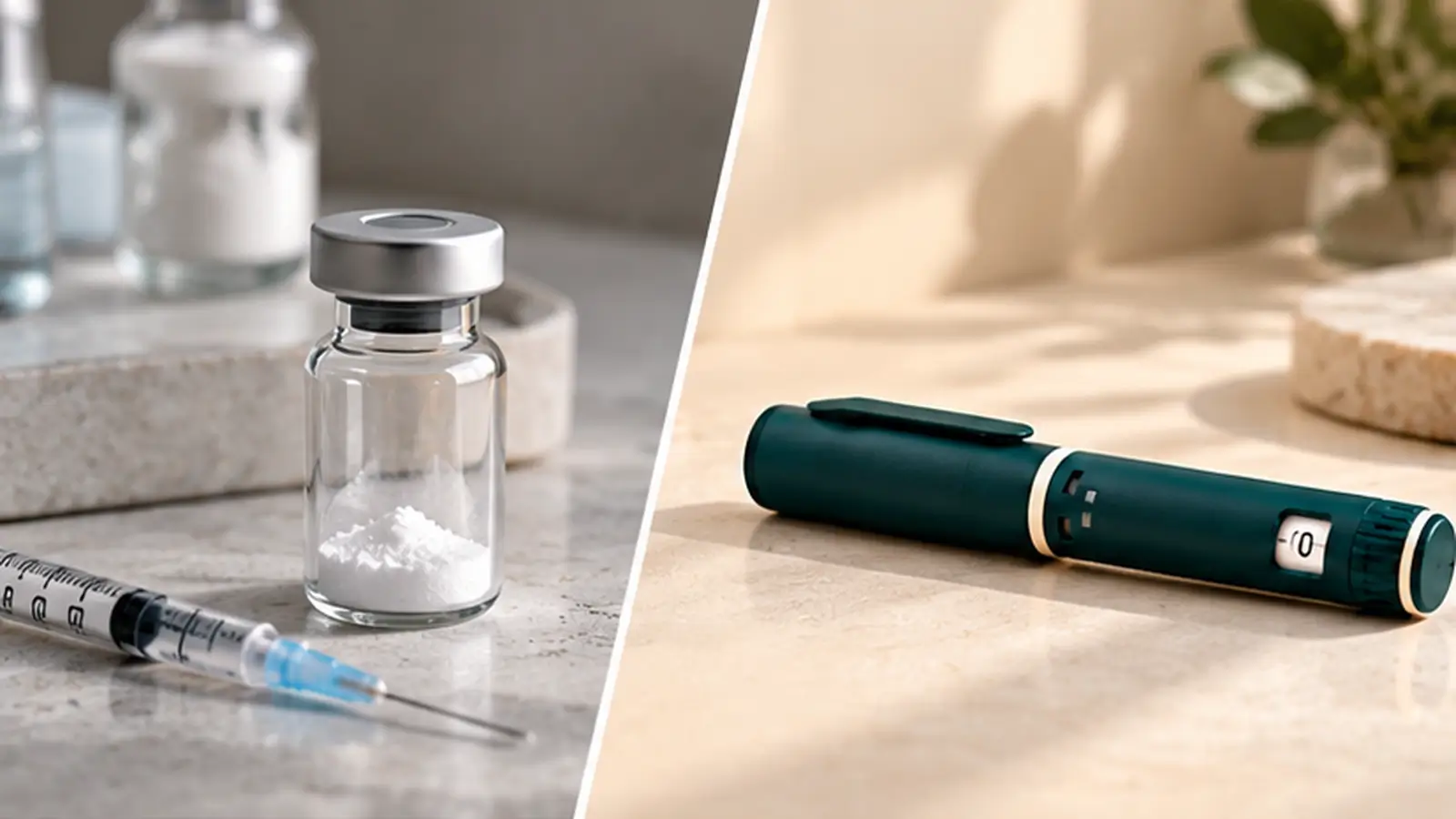
Most research peptides in the UK are sold in glass vials. Open one and you will find no liquid at all, only a small amount of white powder in the bottom. Often so little that people assume the vial is empty.
That powder is the peptide, freeze-dried. Before anything can be done with it, water has to be added, the concentration worked out, and the dose drawn by syringe. A pre-filled pen skips all of it.
This is a comparison of the two formats on the things that actually differ.
Why vials contain powder
Peptides are unstable in solution. Left as a liquid they degrade, and faster at room temperature. Freeze-drying removes the water and leaves a stable solid that survives shipping without refrigeration and sits on a shelf for a long time.
The moment water is added, that stability ends. A reconstituted vial needs refrigeration and has a far shorter usable life than the sealed powder did.
So the vial format is a trade. It ships easily and stores well, and in exchange it pushes the preparation work onto whoever receives it.
What reconstitution involves
Bacteriostatic water is drawn into a syringe and injected slowly against the inside wall of the vial, not directly onto the powder. The vial is swirled, never shaken, until the solid dissolves.
Then the arithmetic. The concentration depends on how much water was added, so 10mg of peptide in 2ml of water is a different concentration from the same 10mg in 1ml. Working out a dose means knowing both numbers and converting to syringe units.
None of this is difficult, but every step is a place to make an error, and an error in the arithmetic is an error in the dose.
What a pen does instead
A pre-filled pen arrives with the compound already in solution, at a known concentration, in a sealed cartridge. The amount is set by turning a dial and reading it in a counter window.
There is no water to add, no concentration to calculate and no syringe to draw from. The counter also tracks what remains, which a vial cannot do.
The trade runs the other way: because the pen contains a solution rather than a powder, it needs refrigerating from the moment it arrives, which is why pens ship in insulated packaging with cold packs.
Side by side
| Vial | Pen | |
|---|---|---|
| On arrival | Freeze-dried powder | Ready to use |
| Preparation | Add bacteriostatic water, swirl, wait | None |
| Dosing | Calculate concentration, draw by syringe | Turn the dial |
| Accuracy | Depends on the arithmetic | Mechanical counter |
| Also needed | Syringes, needles, water, alcohol pads | Needle only |
| Storage before use | Room temperature | Refrigerated |
| Storage after opening | Refrigerated | Refrigerated |
| Tracking what remains | By eye | Counter window |
| Cost per mg | Lower | Higher |
On cost
Vials are cheaper per milligram, and that gap is real. A pen costs more because the manufacturing is more involved: the compound has to be formulated in a stable buffer, filled into a cartridge under sterile conditions, and shipped cold.
Whether that premium is worth paying depends on what the preparation step is worth to you. For some the arithmetic is trivial and the saving is the point. For others, removing a dozen manual steps and the errors that come with them is worth more than the difference.
Which to choose
Vials suit people who are comfortable with reconstitution, want the lowest cost per milligram, and do not mind keeping syringes and bacteriostatic water to hand.
Pens suit people who want the preparation removed, value a mechanical dose counter over manual measurement, and would rather not store a reconstituted vial with an uncertain remaining life.
Nuewell supplies pens only. Every pen is independently lab tested and arrives with its batch certificate published on the product page.
Supplied strictly for laboratory research purposes. Not a medicine, not a dietary supplement, and not for human or veterinary consumption.